





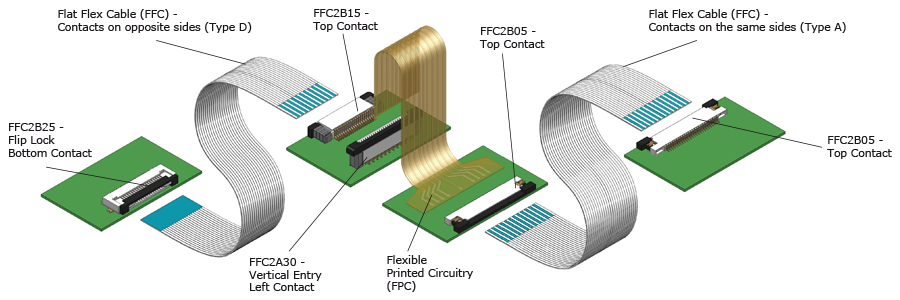
As consumer electronics continue to evolve toward miniaturization and high efficiency, FFC wiring harnesses (Flexible Flat Cables) have become a critical solution for high-performance electrical connections. FFC wiring harnesses are lightweight, flexible, and space-saving, making them ideal for electronic devices that require dense, compact, and efficient connections.
This article explores the innovative applications of FFC wiring harnesses in consumer electronics, emphasizing miniaturized design, superior transmission efficiency, and advantages over traditional cabling. It aims to help engineers and procurement professionals understand how FFC wiring harnesses optimize device performance and design.
What is an FFC Wiring Harness?
An FFC wiring harness is a cable assembly composed of flat, flexible conductors that provide reliable electrical connections in compact spaces. Unlike traditional round cables, FFC wiring harnesses are designed in a flat configuration, allowing them to fit into confined areas while offering high electrical performance. They are widely used in devices requiring high-frequency signal transmission and precise electrical connections, particularly in consumer electronics, computing devices, and smart devices.
Applications of FFC Wiring Harness in Consumer Electronics
1.Smartphones and Tablets
Modern smartphones and tablets demand slimmer, lighter designs. The flexibility and compactness of FFC wiring harnesses make them ideal for connecting displays, batteries, and sensor modules. Their small footprint and bendable design help maximize internal space and simplify circuit layouts.
2.Wearable Devices
For wearable devices such as smartwatches and fitness trackers, miniaturization and battery life are critical. FFC wiring harnesses provide efficient signal and power connections while fitting into extremely tight spaces. Their flexibility allows them to adapt to complex internal layouts, enhancing device reliability and longevity.
3.Laptops and Portable Devices
In laptops and other portable devices, multiple electrical components must coexist in confined spaces. FFC wiring harnesses provide stable power and signal connections between display panels, keyboards, touchpads, and other modules. Compared to traditional cables, they reduce internal wiring complexity and improve assembly efficiency.
As consumer electronics increasingly demand miniaturization, high efficiency, and high integration, FFC wiring harnesses provide unmatched advantages. Their compact size, high signal transmission efficiency, and strong anti-interference capability make them an indispensable solution for modern devices.
Advantages of Miniaturized FFC Wiring Harness Design
1.Space Saving
The compact dimensions of FFC wiring harnesses make them perfect for high-density applications. Their flat structure allows more circuits to be routed within the same space, enabling designers to integrate additional functional modules without increasing device size.
2.Flexibility and Adaptability
The flexible design of FFC wiring harnesses allows them to bend and adapt to irregular or confined spaces. This feature is especially important in devices where traditional rigid cables are impractical.
3.Improved Design Efficiency
Modular FFC wiring harnesses enable customized designs based on device requirements. Their straightforward manufacturing and assembly process reduce production time and costs while improving overall device reliability.
High-Efficiency Features of FFC Wiring Harness
1.Excellent Signal Transmission
FFC wiring harnesses use high-quality conductors such as tinned copper, providing stable signal transmission for both data and power connections. They ensure low-latency and reliable electrical performance in high-speed applications.
2.Strong Anti-Interference Capability
Shielded FFC wiring harnesses can minimize electromagnetic interference (EMI), preserving signal integrity in high-frequency and high-speed applications. This is critical for consumer electronics that demand precise and stable data transmission.
3.High Temperature and Durability
Consumer electronics generate heat during prolonged use. FFC wiring harnesses employ heat-resistant insulation materials capable of operating up to 105°C, ensuring long-term reliability and durability under demanding conditions.
FFC Wiring Harness vs. Traditional Cables
1.Size and Weight Advantage
Compared to round cables, FFC wiring harnesses are lighter and flatter, allowing more signal channels or power lines to fit into a smaller space. This reduces device weight and maximizes internal component density.
2.Ease of Installation and Maintenance
The flexible nature of FFC wiring harnesses simplifies installation and routing. Maintenance is also easier compared to traditional cables, reducing the risk of damage during device assembly or repair.